KITCHEN / PRACTICAL RESEARCH
Mini Chopper vs Food Processor: Choose the Task, Then the Working Space
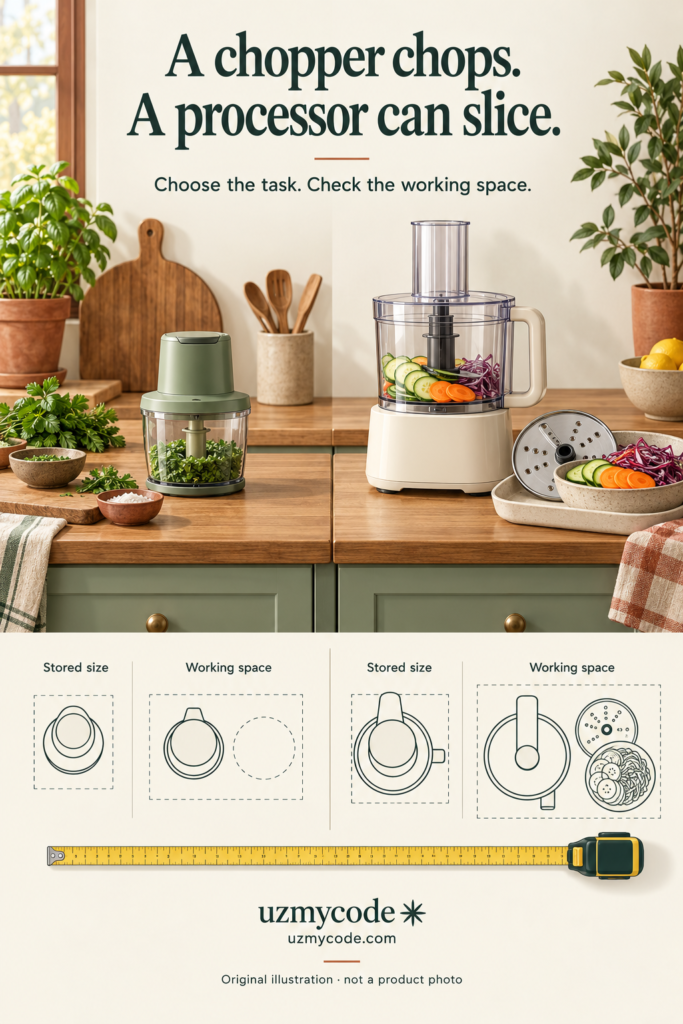
Research-based guide by Uzmycode, prepared with AI assistance. Manufacturer pages and linked US manuals checked October 24, 2026; the FP-9CF exact Amazon variant and generated link were checked October 23 and MCH-4 on October 24. We have not physically tested these appliances.
As an Amazon Associate I earn from qualifying purchases. Affiliate disclosure.
Choose a mini chopper for small chopping or grinding tasks; choose a food processor with the appropriate discs when slicing or shredding is the job. Then plan both a storage spot and a permitted operating area. A machine that fits under a cabinet while unplugged may not be approved to run there. Both Cuisinart manuals discussed here prohibit operating in an appliance garage or under a wall cabinet. [2][4]
Mini chopper vs food processor: choose the cut first
| Your task | What to look for | What to verify |
|---|---|---|
| Small amounts of chopped herbs, onions or a dip | A compact chopper with an appropriate blade | Preparation size and food-specific batch limits in its manual |
| Repeated vegetable slices or shredded ingredients | A processor with a feed tube and the right slicing/shredding disc | Included discs, pushers and the exact bundle |
| Direct sliced/shredded output into a separate bowl | A compatible continuous-feed attachment | Attachment included, receiving-bowl space and assembly requirements |
| An occasional small prep job already handled comfortably | Your current knife, grater or appliance | Whether a new machine solves a recurring problem |
The MCH-4 chopper uses a chopping/grinding blade. The FP-9CF processor includes slicing/shredding discs and a continuous-feed attachment. Those are different capabilities. A product described casually as a “mini food processor” does not necessarily include a disc that produces slices. Check the actual parts list. [1][3]
Bowl capacity alone does not tell you the permitted batch for every food or liquid. Check the manual for the intended ingredient and method. Likewise, a larger motor or higher price does not establish better results for a tiny batch. We have not compared their processing performance.
Measure storage and working space separately
- Choose an approved operating position first. Read the exact manual before planning use beneath cabinets. For the two Cuisinart examples here, a low stored height does not override the prohibition on running under a wall cabinet. Keep a suitable open work surface available. [2][4]
- Record the assembled footprint. Mark width and depth on paper, then add the handle, plug and cord route to your plan. Check dimensions for the appliance rather than its shipping carton.
- Allow for assembly and retrieval. Trace how you would lift the bowl or cover and remove the pusher. A listed assembled height is not a measured lid-removal clearance. We did not find a complete minimum operating envelope for these models, so we do not invent one.
- Make room for food and output. Include the preparation board, ingredients and a receiving container if using continuous feed. A machine’s small stored footprint does not include those.
- Check the route back to storage. Decide whether you can comfortably lift and retrieve the full set without a precarious stack. Keep the stored unit unplugged as instructed.
Planning example: the FP-9CF’s listed assembled height is 15 inches. A 15-inch-high opening therefore does not prove it is usable there: the manual’s location rules, pusher movement and assembly still matter. Treat that dimension as one input, not a fit guarantee. [3][4]
Count the parts before assigning a shelf
Make a list of everything that must come out for your usual job and everything that must go back. An accessory hub can organize sharp parts, but it does not remove the need to store an extra attachment or receiving bowl.
The MCH-4 manual calls for storing the unit assembled and unplugged, with its sharp blade kept out of children’s reach. The FP-9CF instructions specify the provided storage hub for the blade and discs, and say not to store its cover assembly locked. These instructions differ; do not apply one machine’s storage arrangement to another. [2][4]
Give washed parts a place to dry before storage and follow the manufacturer’s cleaning directions. An entire electrical base is not made dishwasher-safe just because some removable parts are. Keep the sharp-parts arrangement clear and deliberate, rather than dropping discs loose into a utensil drawer.
Compact alternative and higher-capability option
Compact chopping option: Cuisinart Core Custom MCH-4
The manufacturer’s White & Stainless four-cup chopper lists an assembled size of 5.6 in L × 7.2 in W × 9.29 in H, Chop/Grind controls, BladeLock and an 18-month limited warranty. It is an option for small prep jobs where slicing discs are unnecessary. Confirm actual batch instructions rather than treating four cups as a universal food limit. [1]
Dimension caution: Amazon’s overview lists 9.29 in D × 5.6 in W × 7.2 in H, assigning these same numbers to different axes. The measurements above follow Cuisinart’s product page. Confirm the current drawing if your storage opening is close to a limit; do not assume the retailer’s 7.2-inch height is correct. The linked variant is MCH-4, White/Stainless Steel. [1]
Upgrade for slicing and shredding: Cuisinart FP-9CF, White
The nine-cup FP-9CF adds fine and medium reversible slicing/shredding discs, an in-bowl storage hub and a continuous-feed attachment. Its maker lists 7.5 × 9 × 15 inches and a three-year limited warranty. The exact White Amazon model is FP-9CF, not a replacement bowl, a renewed machine or the processor without the CF bundle. [3]
Reason to pay more: you repeatedly need its additional cutting formats and have room to assemble and store the complete kit. Reason to skip: your actual task is a little chopped herb or onion, or your current equipment already handles it comfortably. We are not claiming tested speed, quieter operation or better texture.
Offers and bundles can change. Match the complete model and included parts before purchasing. The manufacturer’s stated features and warranty do not establish which option will be the best value for every kitchen.
Run a no-purchase workflow check
Write down three prep jobs you actually repeat. For each, note the desired result, the amount, where you would operate the machine and what would need washing and storing. If the list is mostly occasional small jobs, try your current tools first. If repeated slicing or shredding is the difficulty, a suitably equipped processor deserves a closer look.
Use a paper footprint and an empty receiving bowl to rehearse the counter arrangement. Keep the real appliance unplugged when checking storage. Do not defeat an interlock, use hands as a pusher or substitute a layout exercise for the manufacturer’s operating instructions.
Common questions
Can a mini chopper slice vegetables?
Not merely because it is sold as a mini processor. The MCH-4 example has a chopping/grinding blade; the FP-9CF includes slicing/shredding discs. Choose for the included cutting tools. [1][3]
Can I run a processor under an upper cabinet if it fits?
Follow the exact instructions. Both manuals here prohibit operation under a wall cabinet or inside an appliance garage. Storage dimensions alone do not authorize that operating position. [2][4]
Does in-bowl storage mean every attachment fits inside?
No. Inventory the complete bundle. The FP-9CF hub stores its blade, discs and adapter; its separate continuous-feed attachment and your receiving bowl still need a planned home. [4]
For the surrounding space, see narrow cabinet layouts, scale display and bowl clearance and our small kitchen organization guides.
Sources and specifications
Manufacturer references checked October 24, 2026. External links open in a new tab. This is desk research, not hands-on testing.