KITCHEN / PRACTICAL RESEARCH
Kitchen Scale Fit: When a Mixing Bowl Hides the Display
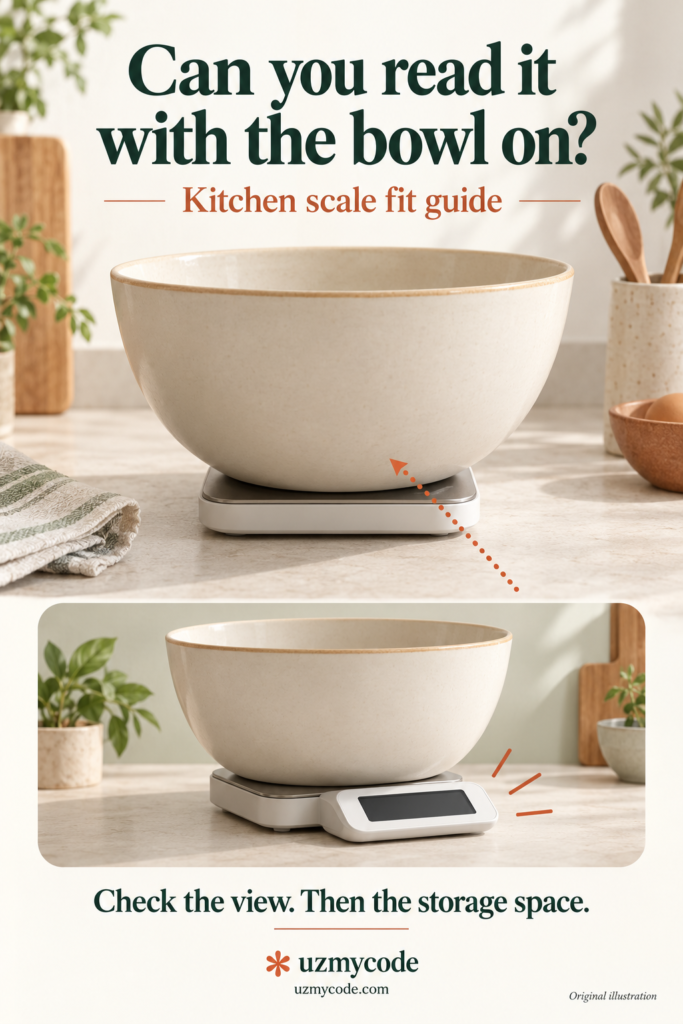
Research-based guide by Uzmycode, prepared with AI assistance. Manufacturer information, exact Amazon variants and affiliate links checked October 22, 2026. We have not physically tested these scales or verified their accuracy independently.
As an Amazon Associate I earn from qualifying purchases. Affiliate disclosure.
If a mixing bowl covers your kitchen scale’s display, first check whether a smaller suitable bowl lets you read it while staying correctly positioned on the platform. If your everyday bowl still blocks the view, a pull-out display is a useful design to compare. Check its extended working space, total load capacity and stored size separately; a scale that fits a drawer can still be awkward on the counter.
Compare researched Amazon options ↓
Start with the bowl you actually use
Put the scale on its intended firm, level work surface and position an empty bowl as the maker instructs. From your normal standing position, check the display and the controls you need to reach. A bowl can hide the numbers, shadow them or block access to the zero button even when its base appears to fit the platform.
Try another suitable bowl you already own before replacing the scale. Keep the bowl supported and correctly positioned; sliding it partly off the platform or lifting it to read the display changes the setup you are trying to measure. Do not use a loose stack of objects as a viewing-height workaround.
OXO describes a hidden or shadowed display as a reason for its pull-out design. That explains the feature’s purpose, but it does not prove that every bowl and counter arrangement will work. Compare your widest everyday mixing bowl as well as the small bowl used for quick portions. [1]
The bowl counts toward the scale’s capacity
Make two notes: the empty container’s weight and the largest quantity of ingredients you expect to add. A zero or tare function makes the ingredient reading easier to follow; it does not turn a lower-capacity scale into a higher-capacity one.
For a hypothetical check, a 1.2 kg bowl plus 3.9 kg of ingredients totals 5.1 kg. That is above a scale’s stated 5 kg maximum, even if the display was reset after placing the bowl on it. This example is arithmetic, not a physical scale test. Use the exact limit and units stated for your model and follow its overload instructions.
A lower-capacity scale may suit small batches. For larger bowls and holiday baking, compare the complete loaded weight before choosing it. Do not interpret a 1 g display increment as a verified ±1 g accuracy guarantee or as proof that it handles tiny quantities reliably.
Measure two footprints: working and stored
Record the closed scale’s width, depth and height for storage. For a pull-out display, make a second layout note with the display fully positioned for reading. Leave room to reach its buttons and keep the scale safely supported on the counter. A dimension for the main body should not be treated as the complete extended working depth.
| Check | Record before buying |
|---|---|
| Display view | Your normal sightline with the widest everyday bowl in place. |
| Working space | Scale, bowl overhang, extended display and accessible controls. |
| Total load | Container plus all ingredients; compare with the named model’s capacity. |
| Stored space | Closed body dimensions and safe retrieval from the intended location. |
| Care and power | Maker’s cleaning instructions and access for battery replacement. |
For drawer storage, use our drawer measurement guide to check the actual closing clearance. Avoid letting other utensils rest on the weighing platform. Keep a clean, dry place for the scale so it can be removed without unloading the whole drawer.
Three researched kitchen scale options
These examples compare display design and capacity. They are not hands-on winners, accuracy rankings or claims that you need a new scale. Match the named size and variant on the current Amazon page.
Pull-out display, 11 lb: OXO Good Grips stainless steel
OXO lists an 11 lb capacity and a display that pulls out to reduce obstruction from bowls or plates, then slides back for storage. It lists 1 g and 0.1 oz increments. Consider it when a fixed screen is the main obstacle and your full load fits its limit. The display still needs usable counter space; we did not verify an extended-depth measurement. Match the 11-pound stainless-steel listing rather than a bundle or older edition. [2]
Fixed display: Escali Primo, Chrome
The maker lists 11 lb / 5,000 g capacity, two-button operation, tare and four-minute automatic shut-off for the Primo family. Its current product page gives 8.5 × 6 × 1.65 inches, while the Chrome Amazon title says 1.5 inches high. Do not approve a tight drawer using that lower figure. The fixed display does not move out from under a wide bowl: check the viewing angle before selecting it. Verified retail model P115, part P115C. [3]
Pull-out display, 5 lb: OXO Good Grips Black, model 11238300
This is the lower-capacity pull-out option, not a smaller version of the 11 lb limit. OXO lists 5 lb capacity, a pull-out display, 1 g increments and a removable platform for hand washing. Its listed overall dimensions are 1.8 × 9.2 × 8 inches. Compare those dimensions with your storage space and check the display when extended. Skip it if your container-plus-ingredients total needs the larger model’s capacity. [4]
Prices, sellers and availability can change. Recheck the exact variant, current manufacturer requirements and your own bowl before purchasing. Keeping your current scale and using a suitable existing bowl may be enough.
Set up a small baking zone before the busy season
Keep the scale where you can set it on a clear work surface and read it comfortably, rather than storing it beneath heavy cookware. Group everyday measuring tools nearby, and give spare packaging a separate place. Our foil and parchment storage guide helps separate daily rolls from backstock; our bakeware storage section covers tray and roasting-pan access.
Kitchen scale display questions
Does a pull-out display guarantee that my bowl will fit?
No. It changes where you can read the numbers. Bowl support, total load, button access and available counter space remain separate checks.
Should I pick the smallest scale for a small kitchen?
Compare the complete task first. A compact stored body is useful only if the scale supports your usual container and leaves the display readable during use.
Can I compare the 5 lb and 11 lb scales by capacity alone?
No. Also compare the exact body dimensions, viewing position, controls, care requirements and storage location. The model names do not establish identical footprints.
Is this an accuracy review?
No. This is a research-based fit and layout guide. Published increments and manufacturer features are identified as such; no calibration or hands-on performance tests are claimed.
Find the next practical project in our small kitchen organization guides.
Sources and specifications
Primary sources checked October 22, 2026. Manufacturer links open in a new tab.
- OXO: why it designed the pull-out display ↗
- OXO: 11 lb stainless-steel scale specifications ↗
- Escali / KitchenSupply: Primo family specifications ↗ The maker’s 1.65-inch height differs from the 1.5-inch Chrome retail title; verify the current exact unit for a tight space.
- OXO: 5 lb scale, model 11238300 ↗