KITCHEN / PRACTICAL RESEARCH
How to Measure a Kitchen Drawer for an Organizer
As an Amazon Associate I earn from qualifying purchases. Affiliate disclosure.
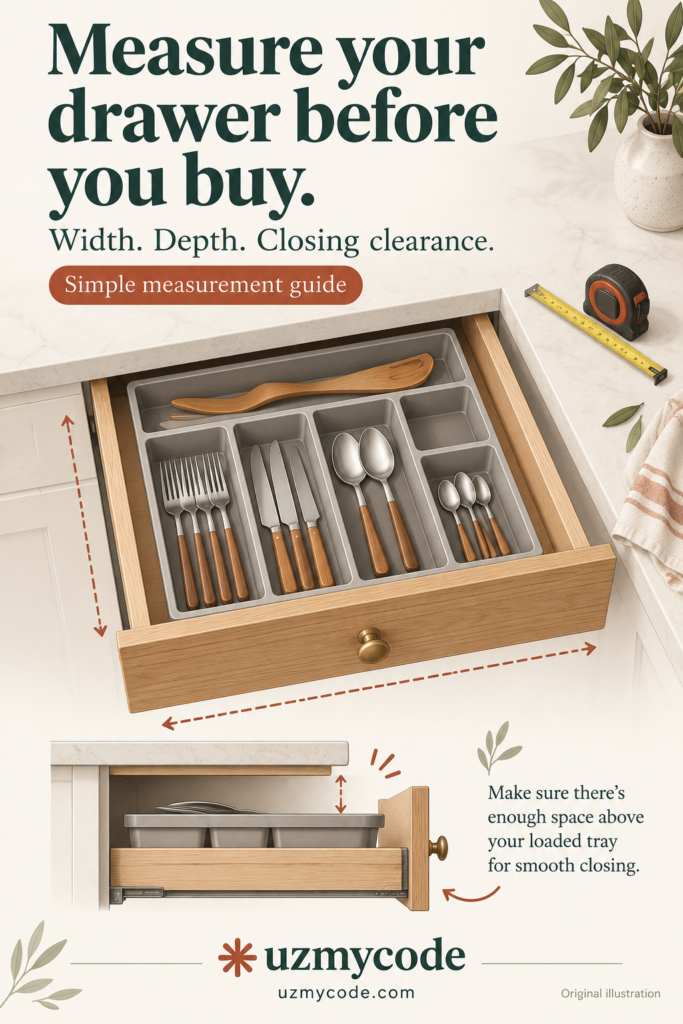
To size a kitchen drawer organizer, measure the usable inside width, front-to-back depth and clearance above the drawer floor when closed. Then compare the exact organizer’s outside dimensions, required drawer height and installation method. A tray can fit on the bottom and still stop the drawer closing once the utensils are loaded.
Compare researched Amazon options ↓
Research-based buying guide. Product specifications and Amazon links checked October 20, 2026. Prepared with AI assistance for Uzmycode. We have not physically tested these organizers; the diagram and worked example explain measurements, not tested performance.
Measure the drawer box, then check what interrupts it
Empty the drawer before choosing a tray. The broad front panel is an unreliable shopping measurement: the organizer must sit inside the box behind it. Keep your tape measure level and record one unit throughout your notes.
- Inside width: measure across the floor near the front, middle and back. If the walls lean inward, repeat at the proposed organizer’s height. Keep the smallest usable measurement along its intended position.
- Usable depth: measure from the inside front wall to the first obstruction at the back. Check both sides and the center. A screw, sloping back or fixed divider can stop a rectangular tray sitting flat.
- Closing clearance: identify the lowest fixed surface above the drawer floor along the closing path. The drawer side’s height alone does not tell you how much space remains above the contents.
- Insertion and removal: check how a rigid tray will pass into the drawer and come out for cleaning. Do not assume a footprint that fits once inside will pass an overhanging counter or frame.
Check the organizer with its intended contents
A ladle bowl, tongs or a stack of spoons can project above a tray. Lay out the items you actually use, not an idealized set that leaves out the awkward pieces. Note the longest tool, widest head and tallest stack. Separate sharp knives from loose utensils using a suitable protective storage method.
For an initial check, make a paper footprint for the organizer and mark its dividers. Place it on the worktop and arrange your utensils over the outline. This tests the proposed layout without buying anything. A paper outline does not reproduce wall thickness, sloped compartments, strength or loaded height.
If you use a lightweight cardboard mock-up to explore clearance, keep it visible and removable, move the drawer slowly and stop at resistance. Do not force a drawer over a hard object or put your fingers in the closing gap. Follow the organizer maker’s stated clearance instead of treating a guessed allowance as a universal rule.
Copy this note before you shop
| Record | What to write down |
|---|---|
| Units | Inches or centimeters; keep product comparisons in the same unit |
| Usable width × depth | Smallest clear measurements at the organizer’s intended position |
| Closing height | Clear space above the floor along the closing path |
| Contents | Longest tool, widest head, tallest loaded group and quantities |
| Support and access | Floor or frame support; obstructions; insertion and cleaning route |
| Candidate | Exact model, minimum/maximum size and any additional maker requirement |
Compare fixed trays at their full outside size. For expanding trays, check the smallest size first, then decide how far the useful compartment needs to expand. For a row of separate bins, add their outside widths and check each depth; the pieces fitting individually does not prove the whole arrangement fits.
Worked example: enough floor space, insufficient height
Suppose your usable drawer measures 18 cm wide × 44 cm deep × 7.5 cm clear height. The gray DrawerStore’s published 11 × 39.5 cm footprint fits within that rectangle. Its 5.7 cm body also looks low enough. However, your 7.5 cm closing clearance is below the manufacturer’s 8 cm minimum. It fails that requirement even before checking your cutlery. [1]
That is a reason to look for a different format, not to force the drawer shut or subtract a convenient number from the requirement. Conversely, a drawer taller than the stated minimum still needs a loaded-content check. Published inch and centimeter figures can be rounded; do not rely on a rounded conversion for a near-equal fit.
Common kitchen drawer sizing questions
Should the tray fill the whole drawer?
No. A smaller tray may leave a useful lane for a long utensil. Make sure it stays stable during ordinary drawer movement, and follow the maker’s method for keeping it in position. Extra unused space alone is not a failure.
Can I turn an organizer sideways?
Only if its complete footprint, compartments and access still work in that orientation. An expanding tray’s extension direction changes when you rotate it. A frame-supported tray must still rest securely on the edges described in its instructions.
How much clearance should I leave?
There is no one allowance established here for every tray and drawer. Use the exact manufacturer’s installation requirements, measurement precision, wall shape and loaded movement. A measurement equal to the listed outside size deserves another check; it is not a comfortable margin.
What if no commercial tray fits?
Keep only daily-use items in that drawer, split the contents between existing containers, or choose a different storage location for bulky tools. Do not cut, tension or install an organizer in a way its maker does not permit.
Sources and specifications
Manufacturer references checked October 20, 2026. External source links open in a new tab. Specifications describe the listed variants; no durability, capacity or ease-of-use testing is claimed.
- Joseph Joseph: gray compact DrawerStore 85119 dimensions and minimum drawer height
- OXO: standard Expandable Kitchen Tool Drawer Organizer dimensions and layout
- YouCopia: DrawerFit tray dimensions, frame support and sliding instructions
The comparison and worked example are Uzmycode’s interpretation of these specifications. Check the selected retailer variant and current instructions before ordering.