KITCHEN / PRACTICAL RESEARCH
Instant-Read vs Leave-In Thermometers: Choose the Task, Then the Storage
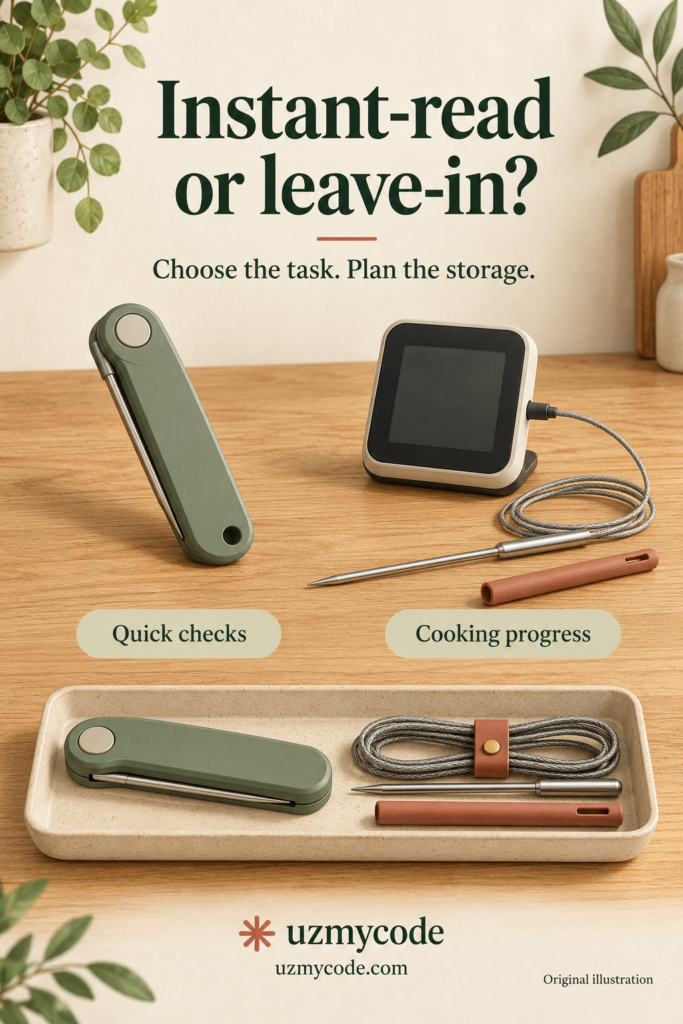
Research-based guide by Uzmycode, prepared with AI assistance. Original three options checked October 22, 2026; Thermapen ONE premium option and its exact Amazon variant checked October 23, 2026. We have not physically tested these thermometers or independently verified their speed or accuracy.
As an Amazon Associate I earn from qualifying purchases. Affiliate disclosure.
An instant-read thermometer is for brief temperature checks; a leave-in model is for monitoring a position during cooking when its manufacturer specifically permits that use. For a wired leave-in model, the food probe goes inside while the electronic display stays outside the oven. Choose the task first, then make space for the complete kit. A folding instant-read can be simpler to store, but it does not replace an oven-rated monitoring probe. [1][2]
Compare researched Amazon options ↓
Instant-read vs leave-in: what each format does
| Your need | Format to consider | What to check |
|---|---|---|
| A brief check in several parts of food | Instant-read | Insertion instructions, readable screen and time for the reading to settle. |
| Follow cooking progress at a probe position | Oven-rated leave-in | Approved probe and cable use, alarm settings and a safe place for the display. |
| Keep a small drawer easy to use | Compare the complete stored kit | Folded body or protected probe length, display and cable storage. |
A leave-in reading describes the probe’s location. It does not certify every part of a large roast or every item on a tray. A quick-check tool lets you move between locations, following its insertion instructions. Do not assume an instant-read model is safe to leave in an oven merely because its measuring range reaches a high number. The TP19H and OXO manuals specifically prohibit oven use for those handheld models. [1][3]
Start with the thermometer you already own if its instructions cover your usual cooking. Add another format when you have a specific unmet task, rather than buying a large set because it has more probes or features.
Check the display position and cable route
For a wired leave-in kit, identify a stable place outside the oven for the display before buying. Check the approved cable route, door closure and room to handle hot cookware. Keep the probe and cable away from heating elements and flames; follow the exact model’s instructions rather than forcing a connector or cable through a tight gap. Never put the electronic display on a hot surface. [2]
Total probe-assembly length is not the same as usable cable reach. The TP16S product page specifies a 47-inch wired probe assembly and a roughly 6-inch metal probe, while other sections describe a 40-inch cord. Do not plan a 47-inch free cable route from that headline. Confirm the current kit’s actual cable and connector arrangement, with enough slack for the maker’s setup. We have not measured a sample. [4]
For an instant-read model, check that you can see the screen and reach its buttons while using the probe as instructed. A rotating or pivoting display may help visibility; it does not establish measurement accuracy.
Plan a home for every part
- Count the components. A wired kit can need space for the display, probe, cable and any covers or clips. A smaller screen alone does not mean a smaller complete kit.
- Check the longest stored piece. Measure a folding thermometer closed, or a straight probe with its suitable protective cover. Do not let a sharp tip face into a hand-access path.
- Give the cable room. Avoid sharp bends, knots and a tightly crimped coil. Use a suitable existing tray to keep parts together without heavy utensils resting on them.
- Store only after cooling, cleaning and drying. Follow the specific care instructions. Water resistance does not automatically mean dishwasher-safe or safe to immerse.
- Check the drawer closes. Test the complete stored arrangement and retrieval, not just the manufacturer’s body dimensions.
The TP16S manual says its probe/cable connection is not waterproof and its parts are not dishwasher-safe; it requires thorough drying before storage. The OXO instructions say to hand wash the probe and keep its digital head out of water. The TP19H manual permits rinsing but prohibits immersion and dishwasher cleaning. These are different care requirements, not interchangeable waterproof claims. [1][2][3]
Use our drawer measurement guide to check the usable interior and closing clearance. Our kitchen scale fit guide applies the same working-space-versus-storage distinction to a baking station.
Four researched food thermometer options
These examples compare formats and handling needs. They are not an accuracy ranking or hands-on winners. Match the exact model and variant on Amazon, and check the instructions supplied with the current unit.
Folding instant-read: TempPro TP19H, Blue
A folding probe, rotating backlit display and one AAA battery suit brief checks followed by compact storage. The maker lists a 6.18 × 1.625 × 0.81-inch body; verify the exact closed arrangement before approving a tight drawer. Its current page advertises a one-second response, while the linked manual describes a readout within four seconds. We did not test that difference. Choose it for the handheld format, not an independently verified speed claim. [1][7]
Wired leave-in: TempPro TempTrack CORE TP16S
This single-probe kit has a separate display, adjustable alert and countertop stand. Its manual requires the display outside the oven, secure probe connection and sufficient cable slack. Compare the complete kit and approved route, rather than just the small display body. It adds monitoring at the inserted position; it does not automatically check the whole meal. Match TP16S, part TP-16s, rather than TP16 or a replacement-probe-only listing. [2][4]
Straight-probe instant-read: OXO Chef’s Precision Digital
This alternative has a pivoting head and a probe cover rather than a folding body. The matched Amazon part is 11168300V1. OXO instructs users to put the shaded probe area in the center of the meat, away from bone, and to wait for the reading to settle. Its manual prohibits leaving it in the oven and submerging the digital head. Check the covered length and cleaning routine when assigning drawer space. [3][8]
Premium quick checks: ThermoWorks Thermapen ONE
Consider paying more if you frequently take handheld readings and want a rotating backlit display, an individual calibration certificate and a longer stated warranty. ThermoWorks lists a 360-degree display, a NIST-traceable calibration certificate and a five-year warranty under its terms. Its advertised one-second response is a manufacturer specification, not our test result; actual response depends on the food and measurement conditions. [9]
The matched Amazon option is Thermapen ONE, Cayenne Pepper Red, not Classic, Mk4 or ONE Blue. The maker now sells selected models on Amazon and advises checking that the seller is ThermoWorks; offers and sellers can change. The ONE remains a handheld instant-read: its instructions prohibit leaving it in an oven or on a hot surface. Store with the probe folded closed and allow room for the 6.1 × 1.7 × 0.74-inch body. Follow its wiping and care instructions; it is not dishwasher-safe. [10][11]
Skip this upgrade if your current thermometer meets your checking needs, or if you need continuous oven monitoring. A more expensive instant-read does not replace a suitable leave-in probe.
Prices, sellers, packaging and available variants can change. Manufacturer specifications are not independent performance tests. A suitable thermometer you already own may cover your needs.
Use current food-safety guidance, not a doneness label alone
Follow current FoodSafety.gov minimum internal temperatures and any required rest times for the food you are cooking. Its chart lists all poultry at 165°F (74°C); other foods have different requirements. The manufacturer’s presets or chef-preference markings should not replace those instructions. [5]
FoodSafety.gov advises placing a thermometer in the thickest part, away from bone, fat or gristle. Follow the probe’s required insertion depth, let the reading settle, and clean it appropriately between uses. A correctly chosen thermometer still needs correct placement and handling. [6]
Common questions
Can I leave an instant-read thermometer in the oven?
Only if that exact model is designed and rated for it. The three instant-read examples in this guide are for handheld checks; their instructions prohibit leaving them in the oven.
Do I need both formats?
Choose for your actual tasks. An instant-read supports brief checks; an approved leave-in probe adds progress monitoring at one position. Owning both can be useful, but it is not necessary for every kitchen.
Is a wireless probe automatically easier to store?
Compare the complete kit, including any charger, dock or accessories. This guide’s leave-in example is wired; its cable and handling rules should not be transferred to a different wireless system.
Does a quicker advertised reading mean better accuracy?
No. Response time and accuracy are separate specifications, and this guide does not independently test either. We focus on the task, handling requirements and stored arrangement.
For the wider prep area, see roasting pan storage and our small kitchen organization guides.
Sources and specifications
Original sources checked October 22, 2026; ThermoWorks sources checked October 23, 2026. Manufacturer and government links open in a new tab.
- TempPro TP19H manual, version 19H-V20260522 ↗
- TempPro TP16S manual, version 16S-V20251212 ↗
- OXO Chef’s Precision digital instant-read instructions ↗
- TempPro TP16S product specifications ↗
- FoodSafety.gov minimum internal temperatures and rest times ↗
- FoodSafety.gov: thermometer placement and safe handling ↗
- TempPro TP19H current product page ↗
- OXO digital instant-read product details ↗
- ThermoWorks Thermapen ONE specifications and warranty ↗
- Thermapen ONE operating and care instructions ↗
- ThermoWorks: official Amazon sales and seller checks ↗