KITCHEN / PRACTICAL RESEARCH
Pantry Bins: Check Shelf Depth and Pull-Out Clearance
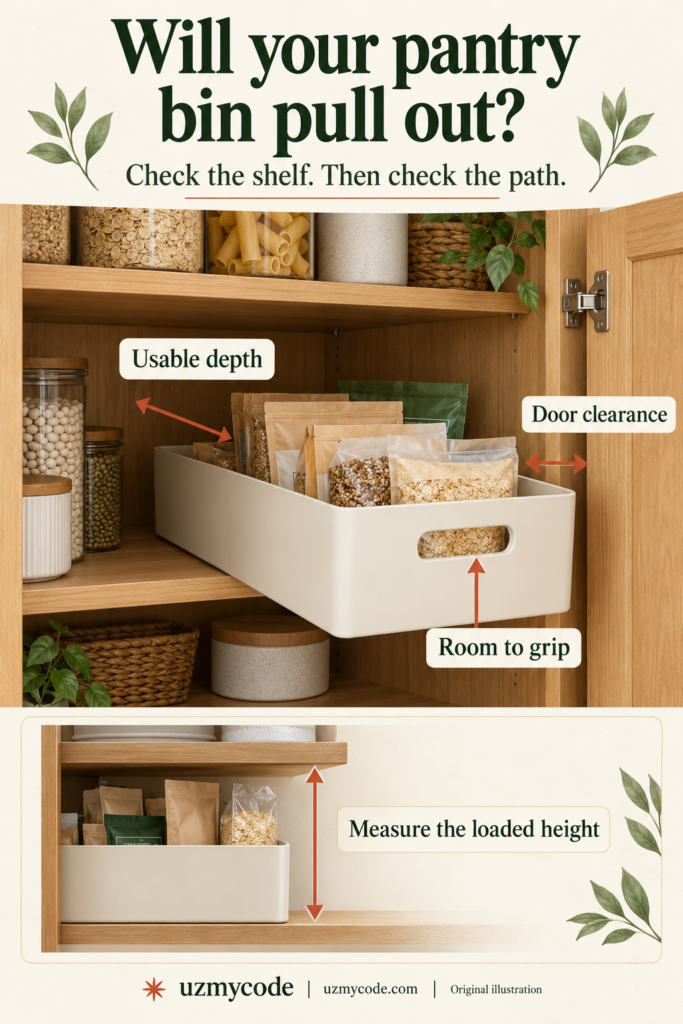
Research-based guide by Uzmycode, prepared with AI assistance. Manufacturer specifications and exact Amazon variants checked October 23, 2026. We have not physically tested these bins.
As an Amazon Associate I earn from qualifying purchases. Affiliate disclosure.
A pantry bin needs to fit twice: on the shelf and through the route you use to remove it. Measure the usable shelf depth, the narrowest opening with the door open, and the height of the bin with your food inside. Then check that you can grip, pull and, when necessary, lift it without catching the shelf edge or door hardware. External dimensions alone do not establish that a loaded bin will be convenient to use.
Compare researched Amazon options ↓
Measure the shelf and the removal route separately
Start with one shelf and one useful group, such as baking packets or snack bags. Remove loose items so you can see the shelf edge and hardware. Write down these checks before choosing a multipack:
| Check | How to measure | What can go wrong |
|---|---|---|
| Usable depth | From the rear obstruction to the shelf’s usable front edge; also check the closed door. | A deep bin projects beyond its support or stops the door closing. |
| Clear opening | The narrowest width on the intended path with the door in its normal open position. | The shelf is wide enough, but a hinge, frame or partly open door blocks removal. |
| Loaded height | The highest part of the actual contents or handle, compared with the opening above. | Tall packets catch even though the empty bin fits. |
| Grip and lift | Space for your hand and any upward movement the bin’s instructions require. | A tightly packed row leaves no workable grip or lifting room. |
| Landing space | A clear supported surface where you can put the removed bin. | You have to balance a full container while finding one ingredient. |
Do not treat the nominal cabinet depth as the shelf depth. A back panel, inset shelf or door fitting can reduce the space you can use. A raised shelf lip also matters: a wheeled organizer is not automatically a drawer on captive runners.
There is no universal extra inch that guarantees a fit. Allow for the actual movement, handles, contents and measurement uncertainty. If the dimensions are almost identical, confirm the current variant and mock up the route rather than rounding in your favor.
Rolling bin or lift-out bin: choose the retrieval task
Consider a rolling bin when you want to bring a deeper group forward on a suitable flat shelf. Check how its wheels and front feet work. For example, YouCopia’s RollOut Pantry Drawer instructions say to lift at the front handle to roll it and use the back handle when lifting it out. That movement needs space; do not assume the bin will clear a lip by pulling straight ahead. [1]
Consider a carry bin when the whole category usually goes to the counter. It can be simpler to move one small group of packets than reach into several tall rows. An open bin does not make the original food packages airtight or replace their storage instructions.
Consider a tiered packet organizer when visibility matters more than maximum depth. Raised rear compartments can make short packets easier to distinguish, but the food still projects above the organizer. Measure your tallest packet in its planned compartment, not just the advertised empty-bin height.
Keep the most frequently used group where you can reach and handle it comfortably. A bin that is easy to move empty may be awkward once filled with jars or cans. Do not assume a load rating that the manufacturer has not provided, and check your shelf’s own support limits. Use smaller groups if the intended load is uncomfortable to handle.
A no-purchase footprint check before you order
- Mark the proposed footprint. Use paper or light cardboard cut to the external length and width. Mark which edge contains the handle and any feet or wheels.
- Check the closed position. Put the outline fully on the shelf. Close the door gently and look for interference; do not force the door or hardware.
- Check the exit path. Open the door normally and move the outline along the intended route. Include the forward movement before any turn. A flexible paper outline is only a screening aid; a rigid bin cannot bend around a hinge.
- Compare height. Hold a ruler beside your tallest package at its planned position. Include the space needed for your hand and any lifting movement.
- Try the grouping with an existing container. If you already own a suitable tray or bin, see whether moving the intended category to a clear counter helps. Do not load a flimsy paper mock-up or use it as a weight test.
Worked example: an opening with 12 inches of usable depth cannot fully support a 15-inch-deep bin in that orientation. A 10.7-inch-deep alternative leaves 1.3 inches of nominal depth, but that subtraction does not confirm the door, grip or loaded-height checks. These are illustrative measurements, not a tested household or a fit guarantee.
Before holiday baking, try one zone for the packets and small ingredients you actually use together. Keep bulky backup packages elsewhere if they make that bin hard to handle. For a January reset, review the category after ordinary grocery shopping before buying matching bins for every shelf.
Three manufacturer-documented options to compare
These three exact-model options illustrate different retrieval needs rather than a tested ranking. Choose by the usable space and the way you retrieve your food. Amazon links below are affiliate links; availability, variants and prices can change.
YouCopia RollOut Pantry Drawer, 8-inch
The current manufacturer page lists 15.0 inches deep × 8.1 wide × 5.6 high, with two adjustable dividers and front/back handles. It calls for a flat surface and hand washing. This is the deeper rolling option here; allow for the instructed front lift. Older brand material gives 15.1 inches of depth, so do not rely on a tenth-inch margin. [1][4]
YouCopia ShelfBin Snack Organizer
The current manufacturer dimensions are 10.7 inches deep × 10.0 wide × 5.2 high. Its stepped layout and two dividers suit small packaged items; the built-in handle supports carrying the group. Compare the wider footprint and raised contents with your opening. The brand specifies hand washing, not a dishwasher. [2]
OXO Storage Bin, SKU 11415800
OXO lists this general storage bin at 14.25 × 8.95 × 4.55 inches and explicitly includes pantry use. Its product page describes an easily transported, wipe-clean format. The linked Amazon variant is model 11415800 in OAT. Its package-dimensions field describes the shipping package, so use the manufacturer dimensions for the bin itself. Confirm orientation and hand clearance before planning a close fit. [3]
Common pantry bin fit questions
Can I put a deeper bin sideways?
Only if the complete footprint, support and retrieval route work in that orientation. Turning the bin changes where its handles and wheels face. A side-facing handle that you cannot reach is not a practical fix.
Should pantry bins be stacked?
Do not assume an ordinary open bin is designed to stack. Choose a model explicitly intended for stacking and check the assembled height and access to the lower contents. If you must remove the top bin every time, include a place to put it and the lifting room.
What if my shelf has wire bars or a front lip?
Check the exact bin’s surface requirements and your shelving instructions. Do not assume small wheels or feet will sit securely on wire bars. A shelf lip may require lifting rather than rolling. If the manufacturer does not clarify compatibility, confirm it before buying.
Do I need to buy bins at all?
No. A single visible row, smaller categories, shelf labels or a suitable container you already own may solve the problem. Buy an organizer when it improves a specific retrieval task rather than only making empty shelves look coordinated.
Keep the rest of the kitchen easy to reach
For upright cookware and bakeware, use our narrow-cabinet storage guide. Small loose lids need a different fit check: see food container lid storage. Rolls that belong in a drawer have their own foil and parchment clearance guide. Browse the small-kitchen organization hub for the complete set.
Sources and specifications
Manufacturer pages checked October 23, 2026. Source links open a new tab. Product dimensions can change between variants; this guide distinguishes documented specifications from our planning examples.