KITCHEN / PRACTICAL RESEARCH
How to Organize Food Container Lids in a Small Kitchen
As an Amazon Associate I earn from qualifying purchases. Affiliate disclosure.
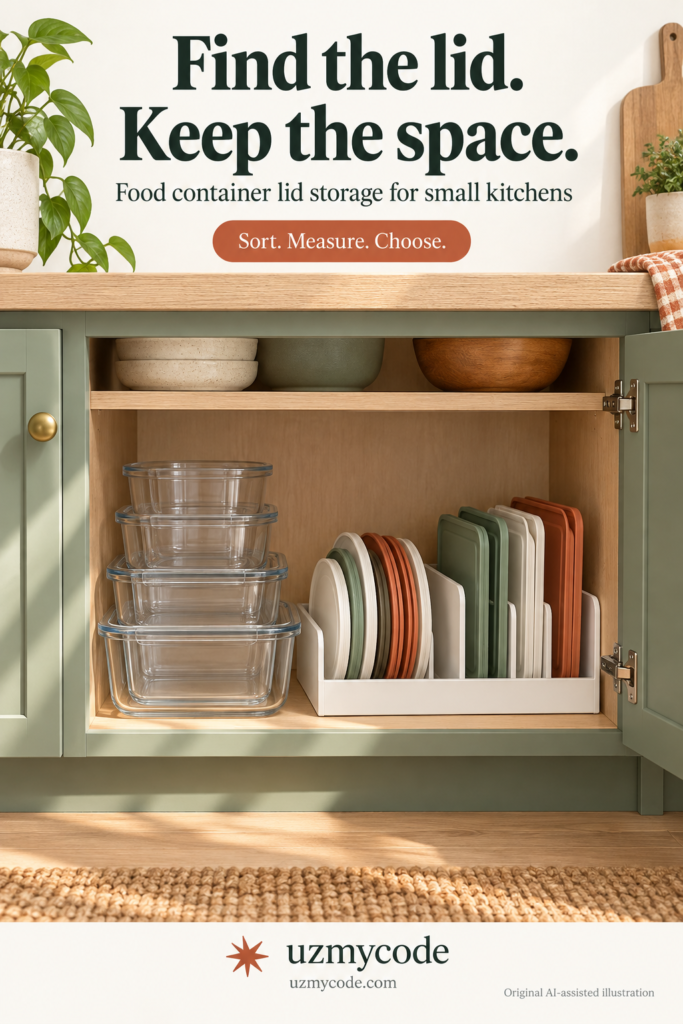
To organize food container lids in a small kitchen, match the lids to their containers first, nest the empty bodies and stand the lids upright in a divided tray or a bin you already own. Choose the location before the organizer: you need space for the largest lid, the loaded height and your hand to lift it out.
Compare researched Amazon options ↓
Research-based guide by Uzmycode, prepared with AI assistance. Specifications and exact Amazon variants checked October 20, 2026. We have not physically tested these products. The original illustration shows a generic layout, not either retail model.
Start with matching sets, not a bigger organizer
Empty the container area onto a clear surface. Match each lid to its actual body; similar-looking rims can belong to different sets. Separate the pieces you use regularly from the large serving containers that only come out occasionally. Check condition and follow each container maker’s care and replacement instructions.
Group the remaining lids by shape and approximate size. Put rectangular lids together, round lids together and small sauce-container lids in a separate compartment. Nest compatible empty bodies without forcing them together. A tall stack that traps the container you use every day is a poor trade for saving a few inches.
Try the existing-bin option first: stand lids in a clean, dry, suitably sized bin you already own. Check that the smallest lid stays contained, the largest does not tip it and each lid can be removed without disturbing the whole row. If that works, you may not need to buy anything.
Drawer, shelf or deep cupboard?
| Location | Useful arrangement | Check before buying |
|---|---|---|
| Deep drawer | Upright lids grouped by size beside nested bodies | Loaded lid height through the complete closing path; drawer movement and tray stability |
| Reachable shelf | A divided tray near the front; bodies alongside it | Space above the tallest lid and a clear route for lifting or withdrawing the tray |
| Deep lower cupboard | A removable tray in a reachable front zone | Door opening, hinges, shelf supports and whether pulling it forward remains comfortable |
| Very small lid collection | One existing bin or a single divided section | Whether a larger organizer would consume more useful space than it saves |
Keep the daily-use container bodies and their lids within the same working area when possible. Reserve less convenient shelves for occasional pieces. For a crowded cupboard, use our narrow kitchen cabinet guide to separate food containers from pan and baking-tray storage.
Measure the lids standing up, not only the tray
- Measure usable width and depth. Use the inside space at the proposed position, allowing for hinges, lips, supports and the opening the organizer must pass through. For expandable models, check both the smallest footprint and the width you actually need.
- Record the largest lid in its storage orientation. Include handles, tabs and projecting edges. Decide whether a rectangular lid will stand on its long or short edge; the change can trade height for depth.
- Check the complete loaded height. A tray’s published body height is not the height of a tall lid standing in it. The base and the lid’s position both matter. Check the lowest surface above the arrangement and, in a drawer, the entire closing path.
- Test the retrieval route. You must be able to grasp a lid, lift it clear of a divider or withdraw the tray. Space that only accommodates a static lid is not enough to prove convenient access.
A paper footprint is useful for checking floor space. Arrange your actual lids beside it to explore grouping, then check the organizer’s compartment and lid-size limits. A paper outline does not reproduce the height of its base, divider spacing or stability. For drawer-specific checks, see how to measure a kitchen drawer for an organizer.
A loaded-height mistake, worked through
Imagine a shelf with 7 inches of clear height and a lid that stands 8 inches tall in the orientation you plan to use. A 3.3-inch-high organizer body might appear short enough, but the upright lid already exceeds the shelf clearance before you account for its support. That layout fails. Rotating the lid may change the dimensions, but you must recheck its width, divider fit and removal route. These are illustrative measurements, not a fit test of the products below.
Two current lid organizers to compare
These are two sizes of the same divided-tray approach, not a hands-on ranking. Choose the smaller footprint that accommodates your real collection. A model name containing “24” or “40” does not guarantee that many of your mixed lids will fit.
Fixed footprint: YouCopia StoraLid 24, model 50933
YouCopia lists a footprint of 13.2 inches wide × 10.8 inches deep, with a 3.3-inch body height. Five adjustable dividers separate lid groups; the maker specifies round and square lids up to 9 inches. Built-in handles provide a way to move the tray. Check loaded clearance and your lid shapes rather than treating the 9-inch limit as a shelf-height requirement. This is the current Large Premium variant, not the older Large Classic. [1]
Adjustable width: YouCopia StoraLid 40, model 50934
The manufacturer’s listed dimensions are 13.2–21.3 inches wide × 10.5 inches deep × 5.8 inches high. Eight dividers and an expanding base offer more room for separate groups. It is a candidate for a wider shelf, but the taller body can rule out a space that accepts the smaller model. Check the usable width at your chosen extension, the loaded lids and the opening needed to move it. Match the current Expandable Premium variant. [2]
Both manufacturer pages specify hand washing rather than dishwasher cleaning. Prices, sellers, availability and selectable variants can change; check the current listing before purchasing.
Keep the layout useful through holiday cooking and everyday use
Before a busy cooking week, pair the containers and lids you expect to use and make room for their return. Keep washed pieces dry before putting them back, following their care instructions. Return each lid to its shape group, with the ones used most often easiest to reach. If a section repeatedly jams, remove an occasional-use set or widen that section rather than compressing the whole collection.
Store occasional large serving-container lids separately when they dominate the daily tray. Labeling the storage location can help a household return pieces consistently; you do not need to label every lid if the groups are already obvious. This guide concerns organizing empty containers, not food storage temperatures or leftover keeping times.
Food container lid storage questions
Should I store containers with their lids attached?
It can make matching simple for a very small collection, but it uses the full volume of each empty container. For compatible nesting sets, separated upright lids can free floor space. Choose the arrangement that stays easy to use in your actual cabinet.
Can a pan-lid rack hold food container lids?
Only when its slot spacing and supports suit those particular lids. A slot made for a thick pan lid may let a small, thin plastic lid fall through. Check the smallest lid as carefully as the largest; do not assume the products are interchangeable.
Is an expandable organizer better?
Only if the additional width solves a real grouping problem and fits the space. Its minimum size, taller body or access requirements can make a smaller fixed tray the better fit. Expandability is a layout option, not proof of greater usefulness.
How much space should I leave above the lids?
There is no universal allowance established here. Follow the exact product instructions, measure your loaded arrangement and check the movement required to take a lid out. A close static fit does not demonstrate comfortable retrieval.
Plan the rest of the area with our small kitchen organization guides and fit planners.
Sources and specifications
- YouCopia: StoraLid 24 current model specifications (opens in a new tab). Dimensions, dividers, lid-size limit and care guidance checked October 20, 2026.
- YouCopia: StoraLid 40 current model specifications (opens in a new tab). Expansion range, body dimensions, dividers and care guidance checked October 20, 2026.